

A manufacturing floor hums with synchronized processes. Traditionally, this relied on manual skills and mechanical precision. Now, digital tools such as automated inventory tracking and predictive sensors are transforming workflows. Yet, these advancements often face a major challenge: the people ex...
You Are Compromised: Cyber Awareness for Individuals
Information Technologies | David Steele | Friday, January 30, 2026
Overview
Data breaches are no longer just headlines—they're personal. This article dives into how cybercriminals exploit stolen data and provides actionable steps to protect your financial and digital life, empowering you to take control in an era where prevention is no longer enough.

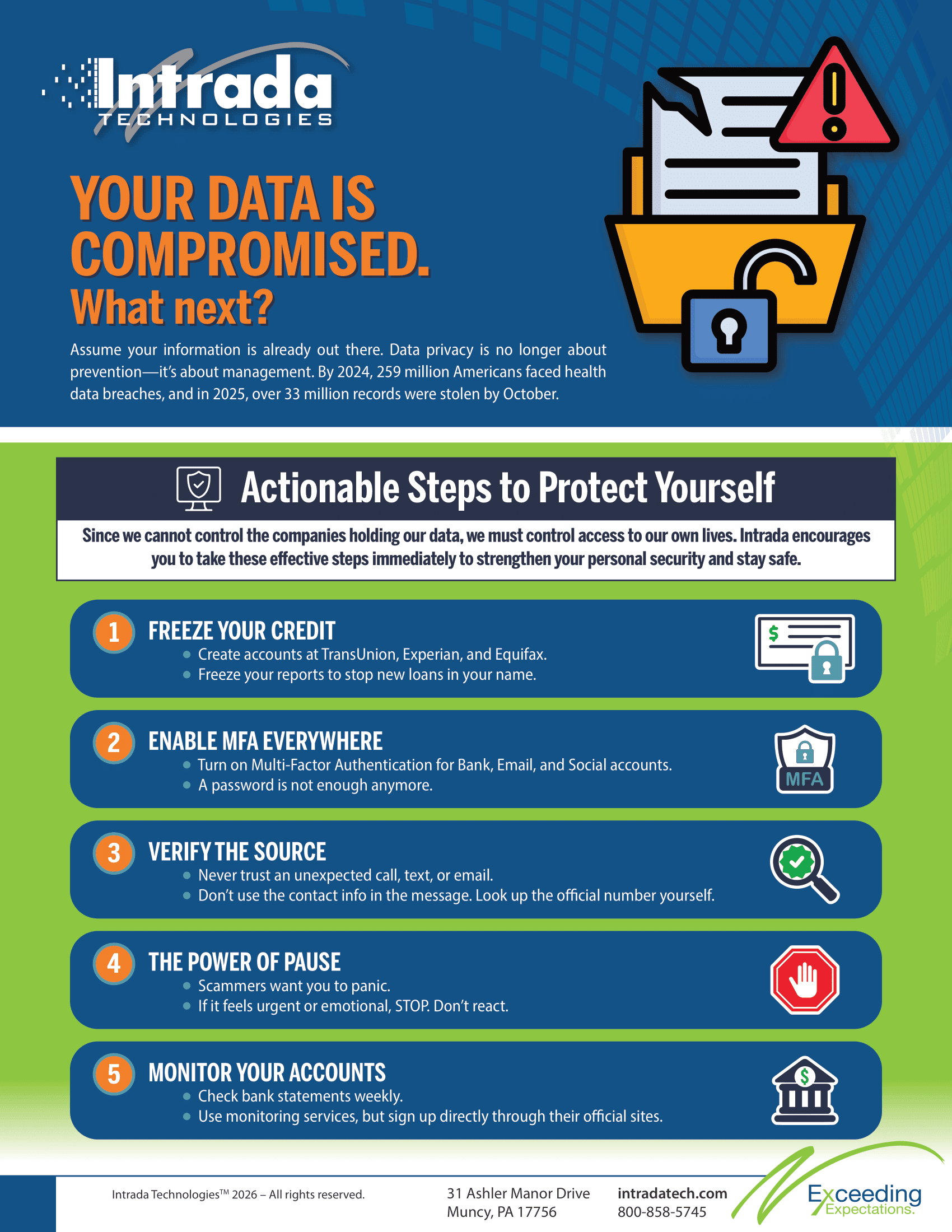
For most Americans, data privacy is no longer about prevention, but management. By the end of 2024, 259 million Americans had their protected health information breached. By October 2025, over 33 million more healthcare records were stolen.
These numbers often seem abstract in headlines, but each digit represents a real name, address, Social Security number, or medical history. The truth is, we should assume our data is already out there: breached, purchased, or stolen.
This article focuses on personal defense over corporate responsibility. We'll examine how cybercriminals exploit exposed data and offer practical steps to secure your financial and digital life.
The Aftermath of a Breach: It’s Personal
When a company is breached, it must report it. You might get a notification months later, often offering a year of free credit monitoring. While helpful, this can give a false sense of closure.
The reality is that the organizations that steal or purchase this data know exactly what they have. They are not just collecting numbers; they are building profiles. A breach at a major healthcare provider or a financial institution gives scammers the missing puzzle pieces they need to trick you.
This enables highly targeted scams. With your actual data, attackers can make their scams look legitimate.
The Targeted Scam
Imagine getting an email referencing your 401(k) provider and a recent transaction, or a text from your bank using your real debit card's last four digits.
These are not random attempts. These are calculated moves based on breached data. By using real information, scammers lower your defenses and trick you into signing in to a fake portal to "resolve the issue," causing you to voluntarily hand over your login credentials.
Scammers often know more about us than we expect. To protect ourselves, we must operate with heightened skepticism.
Actionable Steps to Protect Yourself
Since we can't control companies' data practices, take charge: use these steps now to secure your life.
1. Set Up Monitoring (On Your Own Terms)
If you get a breach notification offering free monitoring, use it. But avoid clicking links in the notification—scammers often send fake notices to exploit confusion.
Instead, go to the monitoring service’s official site. Sign up using the coupon code from the letter. Free offers usually expire in a year or two, so set a reminder before the renewal date.
2. Embrace
Multi-Factor Authentication
(
MFA
)
Passwords alone aren’t enough. Enable
- Financial accounts (Banks, 401k, Investments)
- Insurance portals
- Social media accounts
- Shopping sites (Amazon, Walmart, etc.)
- Email accounts
3. Freeze Your Credit
A credit freeze is a powerful tool. It stops anyone, including you, from opening new credit in your name. If a scammer uses your stolen Social Security number to apply for a card, the application will be blocked because the lender can't check your credit report.
You need to set this up with each of the three major credit bureaus (companies that collect and maintain credit information) separately. It is free to do.
- TransUnion
- Experian
- Equifax
These bureaus have also suffered major breaches. While it feels ironic to trust them, freezing your credit is essential. When you need a loan or a car, you can temporarily thaw your credit.
Trust No One: The Communication Rule
The golden rule of modern cyber awareness is simple: Trust no one who contacts you unexpectedly.
If you receive a call, text, or email claiming there is strange activity on your account, do not engage.
- Do not click the link.
- Do not call the number provided in the message.
- Do not reply with personal information.
Instead, go to the source. Use the customer service number from your credit card, a bill, or the company’s official website. Call directly to verify. Usually, urgent messages are scams.
The Power of the Pause
Scammers rely on urgency. They want you to panic. They want you to act on emotion—fear of losing money, fear of legal trouble, or excitement over a prize.
If a message demands immediate action, pause. Legitimate organizations rarely insist on instant responses. If you weren’t expecting the communication, don’t rush to respond.
Your data may be compromised, but your accounts don't have to be. Act now: treat your personal technology with the same rigor a business uses for its IT security and build a wall around your digital life that is tough to breach.

ABOUT THE AUTHOR
David Steele is the co-founder of Intrada Technologies, a full-service web development and network management company launched in 2000. David is responsible for developing and managing client and vendor relationships with a focus on delivering quality service. In addition, he provides project management oversight on all security, compliancy, strategy, development and network services.
Learn MoreCloud computing isn’t just an IT buzzword anymore — it’s a business imperative for small and mid-sized companies looking to grow, compete, and operate securely in 2026. But with so many options and mixed messages about the cloud, it can be hard to know where to start.This article walks through why m...